
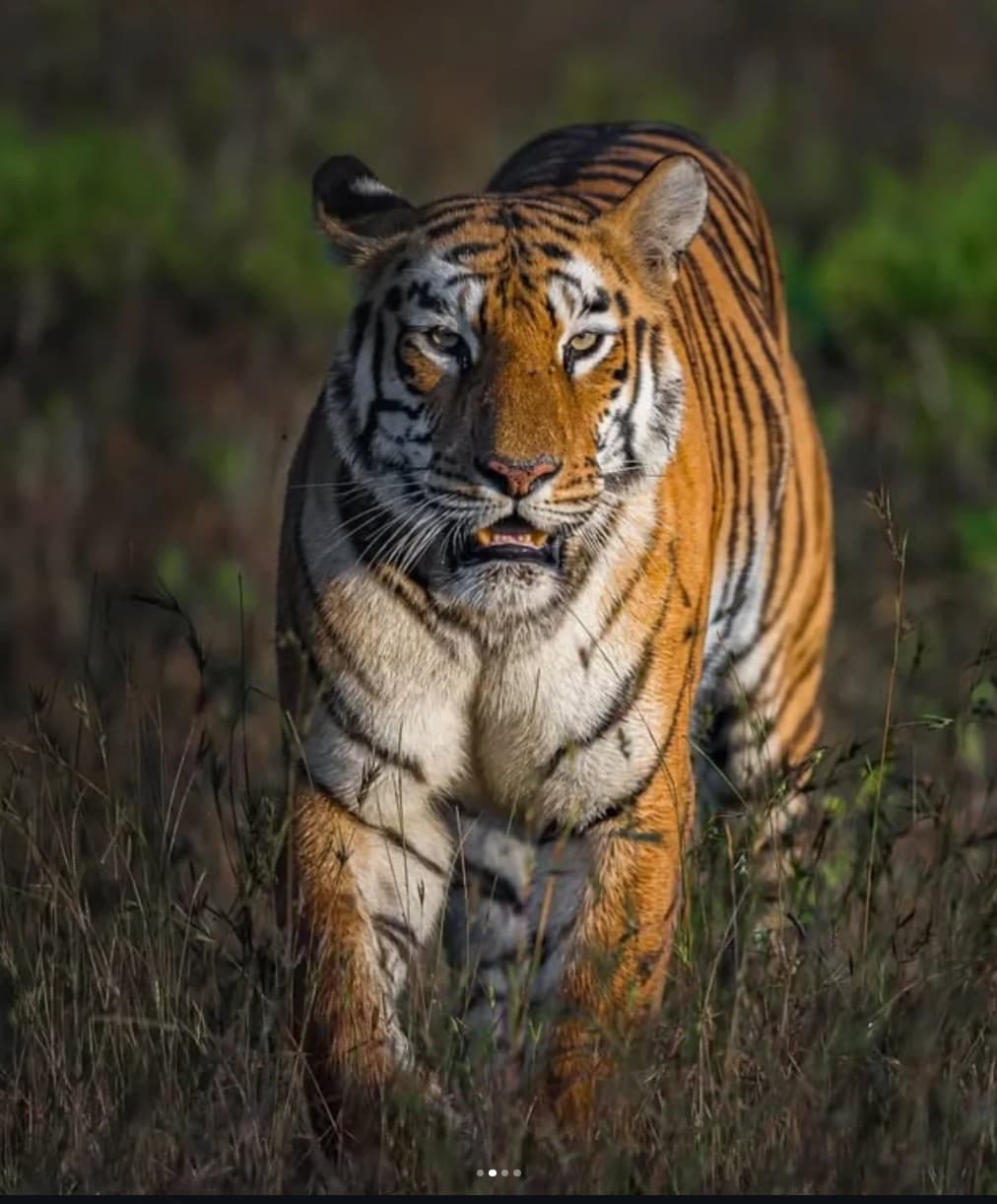
Maya
Female Tigress • 2010 – 2023
Primary Zone
Core Zone
Known Territory
Pandharpauni
Parentage
Mother: Nira (Bala)
Identifying Marks
Distinctive right eye marking
Biography
Maya (T-12), the undisputed 'Queen of Tadoba,' built a formidable dynasty. Born in 2010, she was orphaned young but rose to dominate her mother's territory. She is known for her immense contribution to Tadoba's population over five litters.
The Enchantress of Tadoba: The Life and Legacy of Tigress T-12 (Maya)
The Tadoba-Andhari Tiger Reserve (TATR) in Maharashtra, India, is a highly competitive, resource-abundant ecosystem that serves as a vital stronghold for the Bengal tiger. Yet, within this massive predator landscape, no single animal has encapsulated the complex biological and socio-economic dynamics of the reserve more comprehensively than the female tiger officially designated as T-12. Globally recognized by the moniker "Maya," translating to "illusion" in Hindi, her eventful thirteen-year lifespan (2010–2023) transformed her into a global icon of wildlife conservation and a primary economic engine for regional ecotourism.
This report provides an exhaustive, Maya-centric analysis of her life, deconstructing her historical lineage, remarkable reproductive strategies, unparalleled ecotourism impact, interactions with humans, and the forensic mystery that ultimately surrounded her disappearance.
Territorial Dominion: The Stage for a Queen
To fully appreciate Maya's success, one must understand the specific stage she commanded. Maya established her formidable territory within the Pandharpauni region, a premium tract located within the Moharli and Tadoba core zones. Pandharpauni is a resource-rich expanse characterized by lush, rolling grasslands and critical waterholes, making it an epicenter for herbivore congregation (sambar deer, chital, and gaur) and, consequently, high-frequency predator activity.
Because Maya held this prime real estate, her territory became the focal point of the entire reserve. Accessed primarily via the Moharli and Khutwanda gates, this specific geographic node experienced immense anthropogenic pressure as dozens of safari vehicles converged daily to catch a glimpse of her. Rather than retreating from this pressure, Maya adapted to it, evolving behavioral traits that would define her legacy.
Matriarchal Lineage and Early Survival
Maya’s genetic lineage provides a fascinating look at territorial inheritance. The Pandharpauni region was historically ruled by her grandmother, Jhari (the "Queen Mother" of Tadoba), and later by her mother, Nira (also referred to in popular literature as Leela).
Maya was born in December 2010 to Nira and a dominant male known as the Hilltop Tiger. She was part of a robust four-cub litter, initially designated by researchers as P2. The early ontogeny of these cubs was characterized by severe hardship when, in late 2012, their mother died abruptly, reportedly from a venomous snakebite.
Orphaned at a highly vulnerable sub-adult stage, the siblings faced a hostile landscape filled with infanticidal males and wild dogs. However, Maya—recognizable by a distinct trident-like (or "M" shaped) marking on her cheek—demonstrated extreme boldness. Anecdotal accounts from forest staff detailed the young cub playfully stalking parked motorcycles and stealing lunchboxes, indicating an early, profound habituation to human presence. Her formidable disposition allowed her to outcompete her siblings, forcing them to disperse while she successfully claimed her mother's vacant, highly coveted territory in Pandharpauni.
Reproductive Ecology: Defense and Deception
Over her lifespan, Maya birthed five distinct litters, producing a total of 13 cubs. However, the survival rate of tiger cubs in high-density reserves like Tadoba is inherently low, primarily driven by infanticide from rival male tigers seeking to propagate their own genetics. Maya’s reproductive history is a masterclass in maternal resilience and sophisticated behavioral defense.
When her first litter (sired by the massive male Gabbar in 2014) perished within 15 days, Maya experienced a period of profound reclusive behavior. This trauma fundamentally altered her maternal strategies. During her second litter in 2015 (sired by Saturn), her territory was aggressively invaded by a younger male, Matkasur. Rather than fighting the intruder directly, tracking data suggests Maya actively sought out her former mate, Gabbar, luring the older male back into the core area to fight Matkasur and temporarily protect her cubs.
Most brilliantly, Maya utilized the biological strategy of pseudo-estrus and polyandry. She was observed mating with Gabbar well before her cubs were independent, and shortly after, allowed the previously defeated Matkasur to mate with her as well. By engaging in copulation with multiple dominant males in rapid succession, she induced paternal uncertainty—tricking rival males into sparing her cubs under the assumption that the offspring might carry their own genetics.
Chronology of Maya's Litters
Despite her brilliant defenses, the extreme density of predators in Tadoba exacted a heavy toll on Maya's offspring:
By drawing the relentless attention of up to five dominant males simultaneously, Maya acted as an ecological "shield." Her localized absorption of male aggression allowed neighboring tigresses to raise their litters with reduced threats of infanticide, indirectly stabilizing the broader tiger population of Tadoba.
- First Litter (2014)
Sired by Gabbar. 2 cubs. 0% survival. Died within 15 days, attributed to wild dogs or rival males.
- Second Litter (2015)
Sired by Saturn. 3 cubs. 0% survival. Ultimately killed by the invading male Matkasur.
- Third Litter (2017)
Sired by Matkasur. 2 cubs. 50% survival. Daughter Meera died in an accident. Son Surya survived, was ousted by rivals, and dispersed to Umred-Karhandla Sanctuary to start his own lineage.
- Fourth Litter (2020)
Sired by Tala. 5 cubs. 40% survival. Three cubs went missing due to rival male incursions (including the male Mowgli). Two survived, including a dominant male, Sanju.
- Fifth Litter (2022)
Sired by Balram. 1 cub. 0% survival. As Maya aged, her defensive abilities diminished; the cub was left unprotected upon her disappearance.
The "Maya Effect": Ecotourism and Global Iconography
Maya single-handedly shifted the global wildlife tourism axis toward Maharashtra. Her massive popularity stemmed from a unique behavioral anomaly: an absolute lack of fear regarding human machinery. While most wild tigers exhibit avoidance behavior, Maya frequently utilized man-made dirt tracks to patrol her territory, walking with an unbothered swagger past cavalcades of forty safari jeeps, entirely unfazed by diesel engines and camera shutters.
She hunted in broad daylight in front of idling vehicles and even used the jeeps as visual cover or auditory camouflage while stalking prey. This extreme habituation provided unprecedented access for naturalists and filmmakers. She was the star of the National Geographic documentary Tiger Queen of Taru, which showcased her strategic intelligence and emotional depth. Furthermore, she became the subject of Anant Sonawane's acclaimed book, Maya: The Biography of a Tiger, and had a dedicated Twitter handle (@MayaTadoba) that kept global audiences updated on her daily movements. Her presence directly generated tens of millions of dollars in ecotourism revenue over a decade, funding extensive regional conservation efforts.
Human-Wildlife Conflict and the "Man-Eater" Paradigm
Maintaining a high-density population of apex predators inevitably results in conflict. Throughout her reign, Maya was linked to three—and potentially four—human fatalities. The most notable was the tragic death of a female forest guard, Swati Dhumane, in November 2021.
On the morning of the incident, Dhumane's foot-patrol team encountered Maya resting on a tourist road. After waiting, the team made the fatal decision to take a detour through a dense, adjoining patch of forest brush. From an ethological standpoint, leaving a clear line of sight and entering dense cover triggers a predator's ambush instincts. Maya, interpreting the movement as either a territorial intrusion or fleeing prey, attacked Dhumane.
Following these incidents, there was pressure to declare Maya a rogue man-eater. However, conservationists vehemently defended the tigress. Her years of peaceful coexistence alongside patrolling forest staff and her absolute indifference to thousands of tourists in open jeeps proved she did not actively view humans as a food source; she was reacting purely biologically to environmental stimuli (such as humans crouching in tall grass or moving rapidly through thick brush).
The Disappearance and the Sambar Deer Twist
By mid-2023, Maya had reached the advanced age of 13. Her ability to defend Pandharpauni from constant incursions by younger, robust female tigers—specifically Roma and Bijli—was severely compromised.
Maya was last officially sighted on August 23, 2023. When the park reopened for the post-monsoon season in October, her absence triggered widespread alarm. TATR launched an unprecedented search operation involving over 150 personnel combing a 100-square-kilometer radius. While ten different tigers were recorded moving through her former dominion, no trace of Maya was found.
On November 18, 2023, search teams discovered scattered, highly decomposed skeletal remains deep within her territory. Officials and the media initially presumed they belonged to the legendary tigress. However, a forensic investigation by the National Centre for Biological Sciences (NCBS) in February 2024 revealed a shocking twist: DNA extracted from the bones definitively matched a sambar deer, not a tiger.
While this forensic revelation momentarily raised hopes that Maya might have migrated to a quiet buffer zone, biological realities render her survival highly improbable. At 13 years of age, amidst an aggressively expanding population of robust predators, her eviction from the core territory was an ecological inevitability. Biologists concede she most likely succumbed to natural causes or injuries sustained in a territorial fight with younger tigresses, her remains quietly reclaimed by the dense teak jungle.
Conclusion
The legacy of T-12 extends far beyond viral photographs and documentary footage. She provided a masterclass in behavioral adaptation, utilizing complex reproductive strategies to mitigate infanticide in a hyper-competitive environment. Economically, her unprecedented tolerance of human presence transformed ecotourism in Central India, generating vital conservation capital. While her ultimate fate remains veiled in the mysteries of the forest, the life, reign, and silent disappearance of Maya serve as a profoundly awe-inspiring testament to the realities of India's wild tigers.