
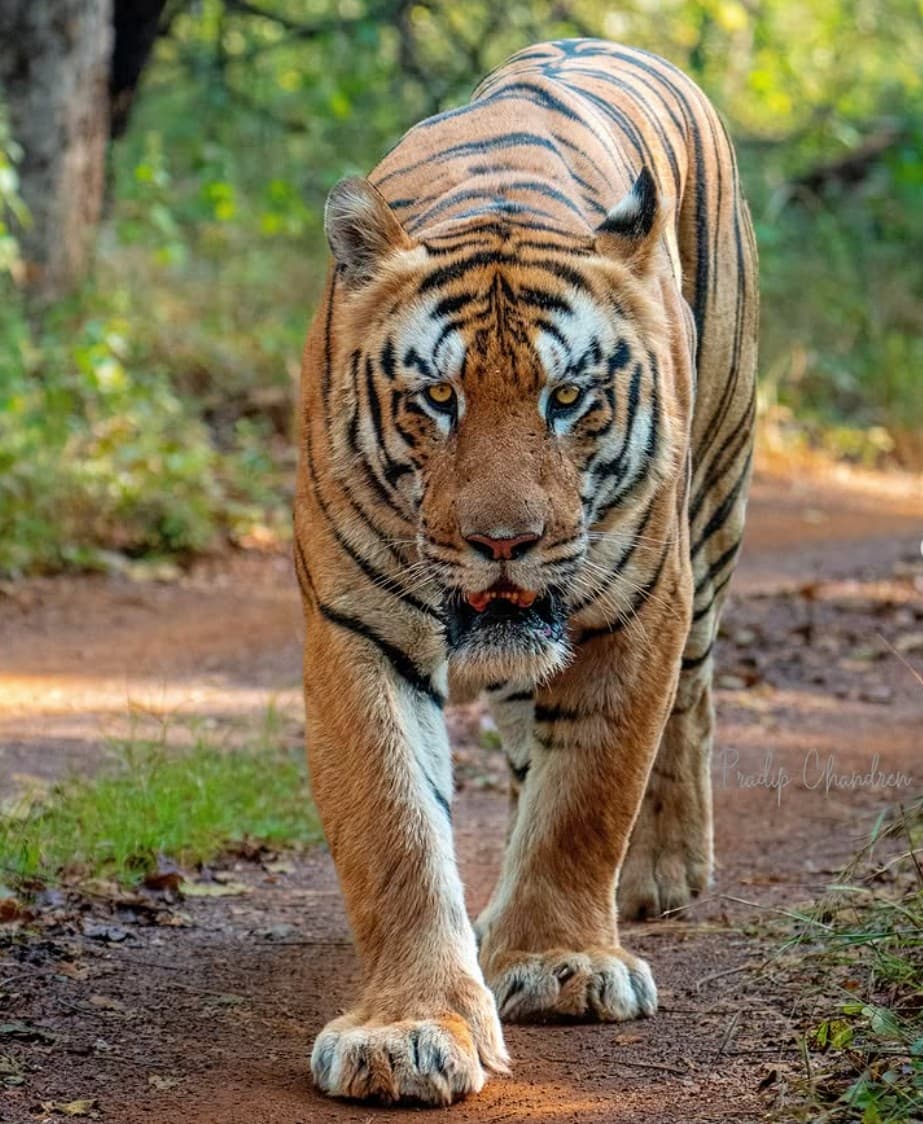
Mowgli
Male Tiger • 2016 – Present
Primary Zone
Navegaon core and Moharli core, navegaon buffer Zone
Parentage
Father: Gangaram | Mother: Kuhani
Biography
Mowgli is a massive, brooding male known for his sheer physical bulk, broad head, and the distinctive, trident-like 'M' pattern etched into his forehead. He is an enduring symbol of Tadoba’s uncompromising wilderness.
The Gladiator of Tadoba: The Epic Saga of Tiger Mowgli
Among the legendary tigers that have shaped the modern history of the Tadoba Andhari Tiger Reserve (TATR) in Maharashtra, few capture the imagination quite like a massive, brooding male named Mowgli. Instantly recognizable by his sheer physical bulk, broad head, and the distinctive, trident-like 'M' pattern etched into his forehead, Mowgli is an enduring symbol of Tadoba’s uncompromising wilderness.
His life trajectory is a cinematic saga of a young prince born in the dense southern peripheries, a warlord who conquered the central zones through sheer force, a patriarch who watched his legacy be erased, and an aging veteran who, against insurmountable odds, continues to patrol a kingdom slipping from his grasp. This is the story of how a single apex predator navigates the treacherous, emotionally charged ecosystem of Central India.
Genesis in the Kolsa Range: Forging a Leviathan
Mowgli was born during the monsoon season of 2016 in the heavily forested Kolsa range, accessible via the Zari and Pangdi gates. He was born into biological royalty, part of a litter delivered by the veteran tigress Kuwani and sired by the dominant male Gangaram. But while his pedigree provided the foundation, it was the specific environment of Kolsa that forged his massive frame.
Unlike the central zones where tigers hunt spotted deer, Kolsa is renowned for its high concentration of Indian Gaur—massive wild cattle where a single bull can weigh upwards of 1,000 kilograms. Hunting these dangerous mega-herbivores requires incredible upper-body strength. Raised on a hyper-caloric, protein-dense diet of Gaur meat during his crucial developmental years, Mowgli matured into an absolute leviathan. He developed a block-like head, thick forelimbs, and a robust chest perfectly adapted for grappling with animals ten times his size.
However, tiger society is fiercely territorial. By 2018, Mowgli and his brother Paras had grown too large, triggering the aggression of older males. When a colossal intruder named Shiva (T-51) initiated a violent takeover of Kolsa, the young Mowgli was forced to flee. This perilous exodus north marked his transition from a displaced subordinate to a conquering warlord.
Territorial Conquest: The Kolara King
The central and northern regions of Tadoba—encompassing the Kolara core, the Alizanza buffer, and the Navegaon zones—represent prime real estate, rich with open meadows and vital waterholes. When Mowgli arrived in early 2019, the territory was held by an aging male named Kali. Leveraging his immense, Kolsa-bred bulk, Mowgli aggressively challenged and deposed the older king.
But claiming a throne in Tadoba is easier than holding it. Mowgli's arrival attracted a coalition of ambitious sub-adults seeking the same prize. In July 2019, this tension culminated in a brutal physical confrontation in the Navegaon-Ramdegi buffer. Engaging a fierce young male named Samrat, Mowgli utilized his superior grappling strength to severely injure and oust his rivals.
By late 2019, Mowgli was the undisputed monarch of the Kolara core and the surrounding buffers. He meticulously scent-marked his boundaries and controlled access to vital waterholes. As an apex predator, he retained his specialized skills from Kolsa, routinely taking down heavily armored Gaur through suffocating throat bites, utilizing his leverage to asphyxiate the massive bovines to sustain his energy for relentless territorial patrols.
The Golden Reign: Bloodlines and Tragedy
With dominance secured, Mowgli's biological imperative shifted to propagating his lineage. Between 2019 and 2021, he formed alliances with two prominent tigresses: Jharni (T-20) and Mayuri.
With Jharni, Mowgli sired a litter that included a bold male later known as Chota Mowgli. With Mayuri, he sired three more cubs, cementing his genetic footprint across northern Tadoba. During this golden era, Mowgli was the undisputed apex of the ecosystem, his rhythmic, heavy gait a physical warning to any challengers.
Yet, the harsh realities of Tadoba permit no lasting peace. In late 2020, Mayuri vanished without a trace, leaving her cubs defenseless; they soon perished, erasing half of Mowgli’s immediate legacy. Furthermore, as his son Chota Mowgli matured, the biological programming of a dominant male took over. Viewing his own rapidly growing son as a threat, Mowgli aggressively exiled him, forcing the young tiger back to the southern fringes of the reserve.
The Clash of Titans: The War with Chota Matka
The most defining and violent chapter of Mowgli’s life is his multi-year war with Chota Matka (T-126), a colossal male of royal lineage seeking to claim Mowgli's territory.
As Chota Matka pushed into the Kolara core in the monsoon of 2021, Mowgli launched a devastating preemptive strike. In a terrifying display of primal warfare, Mowgli severely mauled the younger challenger, inflicting catastrophic facial injuries that left Chota Matka disfigured and forced into hiding.
But the victory was temporary. By April 2022, a fully recovered, heavily scarred, and immensely powerful Chota Matka returned to exact his revenge. The tables turned with brutal finality. In a series of furious strikes, Chota Matka battered and utterly defeated the aging king.
The consequences were absolute. Chota Matka stripped Mowgli of his kingdom across Alizanza and Navegaon. Enforcing the grim law of the jungle, the usurper tracked down and slaughtered the remaining cubs Mowgli had sired with Jharni, subsequently mating with her to replace Mowgli’s bloodline with his own.
Exile and the Emotional Irony of Choti Tara
Following his devastating defeat in 2022, Mowgli was reduced to a transient "floater," a ghost wandering the peripheries to avoid fatal confrontations. Early in 2023, driven by a desperate urge to survive, he drifted south toward the highly volatile absolute core of the reserve—the Pandherpauni area.
It was here that Mowgli's narrative took a profoundly emotional and ironic turn. He crossed paths with Choti Tara, an elderly, deposed matriarch who had been pushed out of her territory by her daughters. More significantly, Choti Tara was the biological mother of Chota Matka—the very tiger who had stolen Mowgli's kingdom and killed his cubs.
In a scenario defying human concepts of enmity, these two aging legends—a deposed, scarred king and an exiled, elderly queen—found solace in each other. Against remarkable biological odds, they mated, and the elderly Choti Tara delivered a final litter of cubs sired by Mowgli. The sight of the battle-scarred Mowgli operating near his playful cubs was a poignant reminder that nature harbors no grudges. Mowgli's bloodline was quietly resurrected through the womb of his greatest enemy's mother.
An Icon of Eco-Tourism
Beyond his violent ecological struggles, Mowgli remains deeply intertwined with the human element of Tadoba. For years, he has been a favorite among tourists and wildlife photographers. Unlike secretive tigers easily spooked by diesel safari gypsies, Mowgli possesses an inherently bold demeanor.
He is known for emerging from dense bamboo, completely ignoring the mechanical clamor and camera shutters. He would stage majestic poses by roadside waterbodies, holding the gaze of awestruck tourists for long stretches. His sheer size, the deep battle scars crisscrossing his face, and his deliberate movements project an aura of absolute authority. For many, seeing Mowgli walk down a dusty forest track is the ultimate validation of the central Indian wilderness.
The Twilight of a Gladiator (2025-2026)
By 2025, Mowgli had reached nine to ten years of age—the twilight of a wild male tiger's brutal lifespan.
When his nemesis, Chota Matka, was severely injured in a fight with another tiger and subsequently removed by forest officials to prevent human-wildlife conflict, a massive territorial vacuum opened. Sensing the void, Mowgli edged back toward his former Kolara kingdom, heavily scent-marking in a desperate bid to reclaim his glory.
But the forest was no longer empty. A new generation of prime-aged males had moved in. This reality culminated in a heartbreaking clash with a robust sub-adult named Collarwala (Mowgli's own biological nephew). Operating on instinct, Mowgli charged the young intruder. However, in a brief, explosive skirmish, Collarwala retaliated violently, landing a severe blow to Mowgli’s face. Bleeding and exhausted, the once-undefeated Mowgli backed away, surrendering the road to the younger generation.
As of 2026, the aging gladiator is struggling. He has lost much of his trademark Kolsa-bred bulk, appearing gaunt. The deep scars on his face—silvery ones from Chota Matka, red ones from new challengers—tell the story of a lifetime of unyielding violence. When sighted resting by the Kolara waterbodies, his breathing is often heavy and labored.
He is a king living on borrowed time, surviving through extreme caution, stealth, and decades of wisdom rather than the overwhelming force of his youth. Yet, as he wanders the dusty tracks beneath the searing sun, he remains a living monument to the unbreakable spirit of the wild—the true gladiator of Tadoba, whose story will echo long after his final tracks fade.
Known Lineage Summary
| Mate | Mating Period | Offspring Details |
|---|---|---|
| Jharni (T-20) | 2019–2020 | Junior Mowgli (Chota Mowgli) | Dispersed to the Zari-Peth buffer within the Kolsa range. |
| Mayuri | Early 2020 | 3 Cubs | Perished after Mayuri vanished mysteriously in Oct 2020. |
| Choti Tara | Early 2023 | Unspecified cubs | A final litter delivered by the elderly matriarch against remarkable biological odds. |