
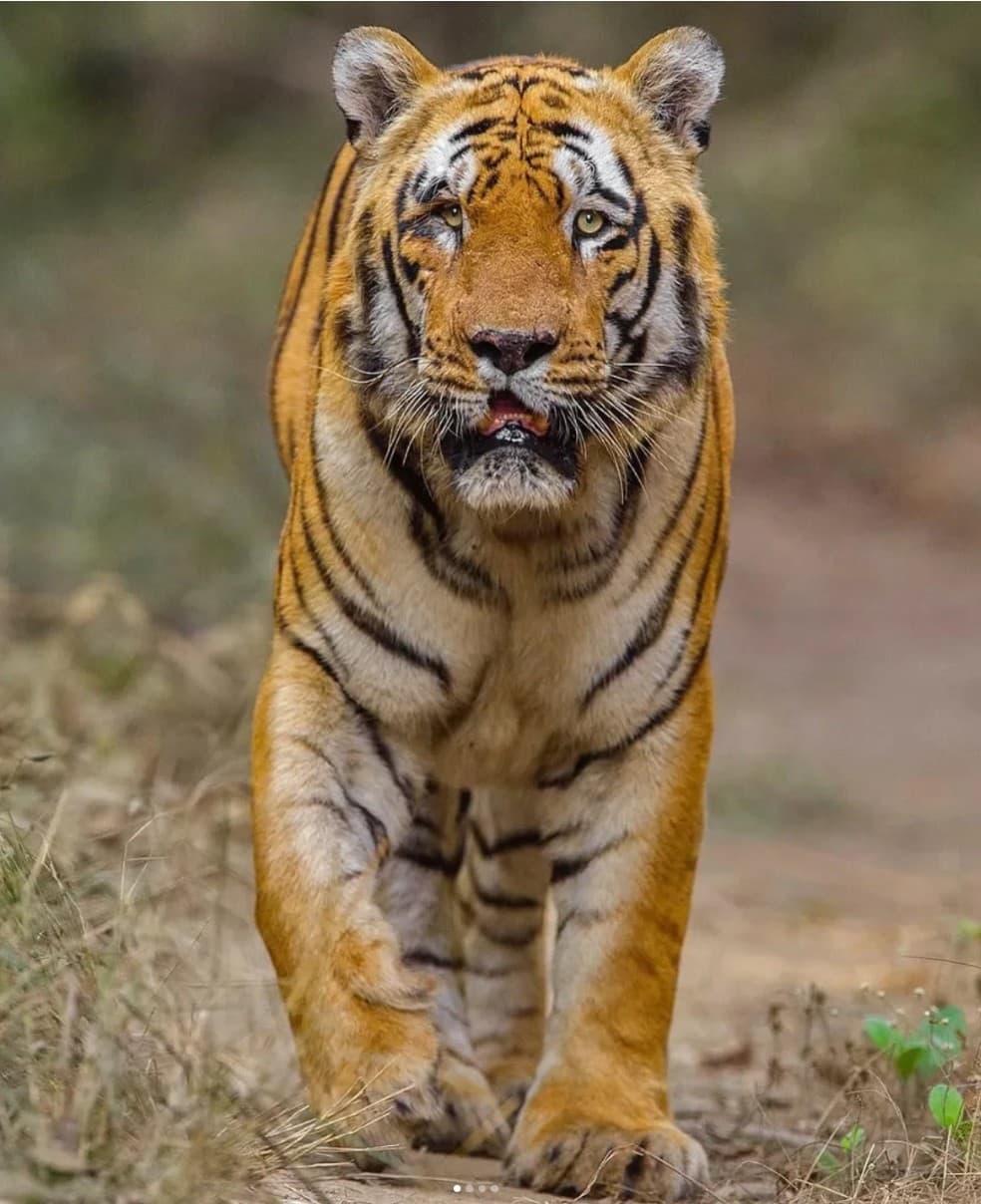
Waghdoh
Male Tiger • 2005 – 2022
Parentage
Father: Sultan
Identifying Marks
Massive size and distinct facial scarring
Biography
Waghdoh (Big Daddy) was a legendary patriarch who sired over 30 cubs. He died of old age at 17 in May 2022, ending an era of absolute dominance.
Affectionately and fearfully referred to by an array of monikers—Scarface, Big Daddy, The Gentle Giant, and The Hulk—Waghdoh was a biological marvel whose life fundamentally altered the genetic makeup, territorial dynamics, and ecotourism economy of the reserve. Born around 2005 or 2006, Waghdoh ruled over the prime territories of Tadoba for a remarkably extended period, defying established scientific paradigms regarding male tiger senescence, parenting, and territorial displacement.
Morphological Architecture and the Anatomy of a Titan
To comprehend the dominance of Waghdoh, one must first analyze his morphological supremacy. The biological parameters of a male Bengal tiger (Panthera tigris tigris) typically dictate a weight range between 180 to 258 kilograms, a body length of up to 3 meters, and a lifespan in the wild of roughly 12 to 15 years. Waghdoh existed at the extreme upper echelon of these metrics.
While sensationalized media reports and local folklore often attributed mythological proportions to him—claiming weights of 300 to 400 kilograms (or up to 800 lbs)—rigorous biological estimations and photographic analyses by experts suggest a more grounded, yet equally terrifying, reality. In his prime, Waghdoh's weight was estimated to be between 240 and 270 kilograms, supported by a massive skeletal frame featuring a chest girth of 136 centimeters, a shoulder height of 101 centimeters, and a straight-line body length approaching 197 to 208 centimeters.
His physical presence was magnified by a distinctively large head framed by thick, orange, mane-like hair, which granted him a regal, lion-esque appearance. His forelimbs and shoulders were hyper-developed, functioning as biological engines capable of generating the immense concussive force required to execute single-stroke kills on massive prey.
The Gaur Confrontation and the Birth of "Scarface"
Waghdoh's most defining physical feature—and the origin of his moniker "Scarface"—was a severe, permanent disfigurement over his right eye. This injury was sustained in his youth, prior to his ascension as a dominant territorial male, during a ferocious hunting encounter near the Vasant Bhandara area of the reserve.
The prey in question was an adult Indian Gaur (Bison), a colossal bovine species where males can easily weigh between 1,000 to 1,500 kilograms. Predating on a healthy adult Gaur is an exceptionally high-risk endeavor for a solitary tiger; standard hunting tactics dictate hamstringing the bovine to bring it down before delivering a crushing, asphyxiating bite to the throat or neck. During this specific encounter, the Gaur's horns struck Waghdoh, resulting in a severe laceration that left him partially blind in his right eye, with the eyelid permanently drooping.
Rather than becoming a fatal vulnerability, this injury forged his legacy. The drooping, scarred eye bestowed upon him a terrifying, battle-hardened visage that mesmerized photographers and wildlife biologists alike. Furthermore, the encounter forced an adaptation in his hunting mechanics; relying less on binocular depth perception, he mastered the art of ambush and brute-force subjugation, becoming Tadoba's undisputed specialist in hunting the massive Gaurs that lesser tigers actively avoided.
The Conquest of Moharli: Ascension to the Throne
The Tadoba landscape, characterized by perennial water sources and an incredibly high prey density, supports a skewed male-to-female sex ratio, resulting in a "war-torn" environment where dominant males hold precarious reigns over a "throne of thorns". In the mid-to-late 2000s, the prime Moharli range of the core zone—arguably the most fertile and contested territory in the reserve—was ruled by a formidable, ill-tempered male known as Yeda Anna (T-34, also known as Crooked Tail).
Both Yeda Anna and Waghdoh shared a prestigious, aristocratic lineage; both were presumed sons of Sultan, an ancient patriarch of the Moharli range. By 2010, the burgeoning Waghdoh, named after a specific waterhole in his natal area where he was first sighted by tourists in 2009, began his campaign for dominance.
The warfare among male tigers is usually based on advanced deception—urine spraying, clawing tree trunks to visually demonstrate height, and depositing chemical pheromones—to avoid physical combat that could lead to debilitating, starvation-inducing injuries. However, the clash between Yeda Anna and Waghdoh transcended posturing.
In late 2010, the two titans engaged in a brutal territorial war at the Kosba line. Overpowering the older king through sheer mass and youthful stamina, Waghdoh decisively trounced Yeda Anna, driving the former sovereign out of the prime Moharli territory and forcing him to retreat to the fringes of the Khatoda and Katezhari areas.
The Strategy of Infanticide
Waghdoh's victory initiated an immediate, brutal ecological reset. At the time of the takeover, the resident prime tigress, Madhuri (T-10), was rearing her first litter of three cubs, sired by the ousted Yeda Anna. In a classic display of evolutionary feline infanticide—a biological mechanism designed to eliminate rival genetics and force the female back into estrus—Waghdoh systematically tracked down and killed all three of Madhuri's cubs. This harrowing act established Waghdoh as the absolute sovereign of an empire spanning over 80 square kilometers, cementing his bloodline's exclusive future in the Moharli core.
A Dynasty of Matriarchs: Litters, Consorts, and Genetic Proliferation
Following the infanticide, Madhuri submitted to Waghdoh, marking the beginning of one of the most prolific and consequential breeding partnerships in modern tiger conservation history. Over his lifespan, Waghdoh would sire an estimated 35 to 40 cubs across multiple tigresses, a staggering genetic contribution that earned him the moniker "Big Daddy of Tadoba".
His reproductive success was not limited to a single mate. As his territory expanded, he formed alliances with several prime tigresses, dictating the genetic future of both the core and buffer zones. With Madhuri (T-10) in 2011, he sired the globally famous Telia Sisters—Sonam, Lara, Geeta, and Mona—who became renowned for their unprecedented cooperative hunting behavior. A second litter with Madhuri in 2014 included the tigress Choti Madhu, born in the buffer zone after Madhuri was displaced from the core. With Kori (Old Waghdoh Female), he sired the massive male Shiva in 2014 (who later dominated the Kolsa range) and Shambhu (the 'Gladiator') in 2017. He also mated with Maya (T-12), the Queen of Tadoba, producing the tigress Jharni. Other consorts included Aishwarya, Pakhi, and Bala, across whose territories he actively protected cubs from rival males.
The Telia Sisters Phenomenon
Of all his offspring, the 2011 litter sired with Madhuri generated the most significant scientific and public interest. The four female cubs—Mona, Geeta, Lara, and Sonam—grew up around the Telia Lake region of the Moharli zone. Their formative years were extensively documented by international film crews, culminating in the globally broadcast documentary Tiger Sisters of Telia (aired on Discovery Channel as Tigress Blood).
Standard behavioral models dictate that sub-adult tigers disperse to form solitary territories. However, faced with the intense competition of Tadoba, these four sisters defied solitary norms and formed an unprecedented alliance. They hunted cooperatively, akin to a lion pride, utilizing coordinated tactics to take down highly dangerous prey, including Sloth Bears and adult Gaurs. Eventually, natural instinct superseded this alliance; the fiercely aggressive Sonam ousted her sisters and her mother, Madhuri, claiming the prime Telia lake territory for herself, while Lara established dominance in the adjacent buffer areas.
The "Family Man" Anomaly: A Behavioral Paradigm Shift
Male tigers are universally classified as solitary, highly territorial animals that play absolutely no role in the rearing or provisioning of their offspring; in many cases, males are a direct threat to cubs if paternity is uncertain. Waghdoh profoundly defied this biological stereotype, exhibiting behaviors that forced researchers to re-evaluate the social dynamics of Panthera tigris.
Waghdoh was, remarkably, a devoted and protective patriarch. He was frequently documented spending vast amounts of time with his cubs across multiple litters, actively guarding them against nomadic males, and engaging in gentle play with the young. Wildlife photographers and biologists observed him sharing his massive kills with his various mates and their litters, demonstrating a level of familial tolerance virtually unheard of in dominant males.
This protective behavior generated a massive second-order ecological impact regarding cub mortality. In high-density reserves like Tadoba, cub mortality is exceedingly high due to infanticide by rival males. Because Waghdoh actively patrolled his territory and lingered near his nurseries, the survival rate of his litters approached an astonishing 100% during his prime. His protective umbrella allowed cubs to remain in the safety of his territory for extended periods—well past the typical dispersal age of 17 to 24 months—allowing young tigers to receive extensive, undisturbed hunting training completely shielded from the constant threat of assassination that plagued the core zones.
The Royal Durbar: Ecotourism and the Mechanics of the Hunt
Waghdoh was the primary catalyst for Tadoba's explosion onto the global wildlife tourism map. Prior to his reign, Tadoba was a relatively obscure reserve overshadowed by high-profile parks like Ranthambore, Bandhavgarh, and Kanha. Waghdoh changed this trajectory entirely, drawing thousands of domestic and international tourists to the Moharli core gate and its surrounding buffer entry points.
His sheer size, combined with a majestic, unhurried demeanor, made him an icon. Waghdoh exhibited an astonishing tolerance for safari vehicles, viewing the noisy diesel gypsies and the frantic clicking of camera shutters with a gaze of absolute contempt and indifference. Local guides and naturalists affectionately joked that Waghdoh held durbar (a royal court) only once a week; he was notoriously "lazy," often relying on the kills made by his female consorts to gorge himself.
Observers consistently noted that when Waghdoh moved, the jungle underwent a dramatic acoustic shift. The frantic alarm calls of langurs, chital, and sambar would reach a fever pitch before an eerie, suffocating silence descended. His territorial roar was described as a low-frequency thunder that vibrated through the ribcages of those nearby—an auditory weapon that shook the earth and forced even safari elephants to halt in visible distress.
Despite his reputation for lethargy in later years, Waghdoh in his prime was a calculating and devastatingly effective hunter. His immense chest and shoulder musculature allowed him to wrestle adult Gaurs to the earth—a feat few other male tigers could accomplish with consistency. Even as he aged, his sheer presence was enough to command the spoils of the forest, with tigresses allowing him to commandeer kills as a biological "tax" in exchange for his protective services.
A Chronicle of Conflict: Battles, Defeats, and the Buffer Zone Retreat
In the unforgiving mathematics of the wild, senescence is the ultimate conqueror. A wild tiger's physical prime typically spans from 5 to 10 years of age. By 2014–2015, Waghdoh was approaching 10 years old, having ruled the prime Moharli core for an astounding five years—an eternity in Tadoba's hyper-competitive ecosystem.
Prior to 2009, Waghdoh's victory over an adult Indian Gaur near Vasant Bhandara cost him his right eye but established his legend. In 2010, he defeated Yeda Anna (T-34) to claim the Moharli core, executing infanticide to reset the territory's bloodline. By 2014–2015, facing the younger and immensely powerful Bajrang (T-49), Waghdoh made a calculated strategic retreat from the Moharli core to avoid a fatal confrontation. Bajrang subsequently mated with Waghdoh's own daughter Sonam, beginning a new dynasty. By 2016, another challenger, Khali (T-55), pushed Waghdoh out of the Dewada buffer zone, reducing the monarch to a nomadic existence across fringe territories.
The Transformation of Buffer Zone Ecology
When the "Big Daddy" of Tadoba relocated to the buffer zones following Madhuri, the entire tourism industry pivoted to follow him. Waghdoh single-handedly popularized buffer zone safaris in Tadoba, particularly through the Devada, Junona, and Agarzari gates. He proved that the fringes of the park offered spectacular, less-crowded photographic opportunities.
This decentralization of tourism was a massive conservation victory. It reduced vehicular pressure on the sensitive core zones while generating unprecedented revenue for fringe villages. By creating a sustainable ecotourism economy in the buffer, Waghdoh transformed local communities from potential poachers into fierce, economically incentivized protectors of the tiger.
Anthropogenic Hazards and the Tragic Twilight
The buffer zone offered a temporary sanctuary, but no permanent respite from the pressures of age and competition. In 2016, Waghdoh was violently pushed out of the Dewada area by Khali (T-55). Over the next several years, the once undisputed monarch was reduced to a nomad, wandering through the Junona, Lohara, and Mamla forest areas—forced to actively avoid the prime territories now ruled by his own sons and grandsons.
During this period, Waghdoh demonstrated remarkable adaptability and restraint. Despite living in areas with extremely high human density, he strictly avoided conflict with people, sustaining himself on wild prey for as long as his aging body allowed. He was once sighted miraculously surviving a crossing of the active Chandrapur-Gondia railway track, a stark reminder of the deadly anthropogenic hazards facing aging tigers.
By May 2022, Waghdoh was 17 to 18 years old—an almost unprecedented lifespan for a wild male tiger. His massive frame had withered into a skeletal shadow of its former glory. In his final weeks, he was tracked near the Durgapur Open Cast Coal Mine and the Sinhala forest, just outside Chandrapur city. Viral videos showed the legendary Scarface stumbling, severely emaciated, and struggling to walk.
On May 21, 2022, driven to the absolute brink of starvation and delirium, the old tiger attacked and killed a 65-year-old shepherd, Dashrath Pendor. This desperate act was not the behavior of a habitual man-eater, but the final, tragic necessity of a starving, cornered predator acting purely on survival instinct.
The Maharashtra Forest Department and the NTCA made a poignant, ethically profound decision—recognizing that capturing and caging a wild monarch in his final, painful moments would strip him of his innate dignity, they chose to monitor him strictly from a distance, allowing nature to take its inevitable course. He had lived his entire life as a wild king, and he deserved to die as one.
On the morning of Monday, May 23, 2022, forest personnel discovered Waghdoh's colossal body lying peacefully in the undergrowth. An official autopsy confirmed he died of senescence—all his limbs, canines, and internal organs were intact, definitively ruling out poaching or poisoning. The titan had simply run out of time.
Conclusion: The Eternal Echo of Waghdoh's Roar
The death of T-33 marked the end of an epoch in Indian wildlife history. Waghdoh was far more than a magnificent tourist attraction; he was an ecological architect who reshaped the biological and economic landscape of the Tadoba-Andhari Tiger Reserve. His life fundamentally challenged our understanding of tiger sociology, proving that male tigers can exhibit profound paternal care, emotional loyalty to mates, and a capacity for co-existence that directly and positively influences the survival rates of their species.
Today, the blood of Waghdoh courses through the veins of central India. His daughters, including the surviving Telia sisters and Choti Madhu, continued to dominate their respective ranges. His granddaughters, such as the magnificent Chanda, have been selected for historic translocation projects to revive the Sahyadri Tiger Reserve, carrying his robust, battle-tested genetics across Maharashtra. His grandsons and great-grandsons—gladiators like Chota Matka, Shambhu, and the majestic Shiva—now wage their own bloody wars over the territories he once conquered.
Waghdoh's legacy is etched not only in the genetic vitality of Tadoba's thriving tiger population—which now boasts over 115 individuals, making it one of the most densely populated tiger habitats on earth—but in the very economic framework of the region. By pushing tourism into the buffer zones, he inadvertently secured a vast, economically viable protective ring around the core forest, ensuring that future generations of tigers have the space to roam, hunt, and breed under the watchful eyes of the local communities he helped enrich.
When the dry wind sweeps through the bamboo thickets of Moharli, and the langurs issue their haunting alarm calls into the suffocating heat of the Vidarbha summer, the spirit of the Scarface King remains palpable. Waghdoh lived a life of absolute sovereignty, fierce combat, and surprising gentleness. He died as he lived—unbowed, untamed, and forever the undisputed Big Daddy of Tadoba.
Known Lineage Summary
Waghdoh sired an estimated 35 to 40 cubs over his lifetime. Below is a summary of his known mating partners and surviving offspring.
| Mate | Mating Period | Offspring Details |
|---|---|---|
| Madhuri (T-10) | 2011 | Mated in Moharli Core. 4 surviving cubs: Sonam, Lara, Geeta, Mona (The Telia Sisters). |
| Madhuri (T-10) | 2014 | Mated in Moharli Buffer. 4 cubs born, 3-4 survived and dispersed into the surrounding buffer zones. |
| Devdoh Female (T-8) | ~2013/2014 | Mated in Devdoh / Khutwanda. 4 cubs born, 3 survived (1 male died in 2014). Known surviving cub is Bala (Nira). |
| Kori (Old Waghdoh Female) | 2014 (or earlier) | Mated in Waghdoh Area. Gave birth to Shiva, who later settled in Tadoba's South zone (Kolsa), and Pakhi (New Waghdoh Female), who established territory in Waghdoh. |
| Kori (Old Waghdoh Female) | 2017 | Mated in Waghdoh Area. Gave birth to Shambhu. |
| Various Unidentified | 2011-2016 | Mated in TATR Core & Buffer. ~21-26 cubs born. Widespread throughout the ecosystem. |